Website Development for Clothing Stores
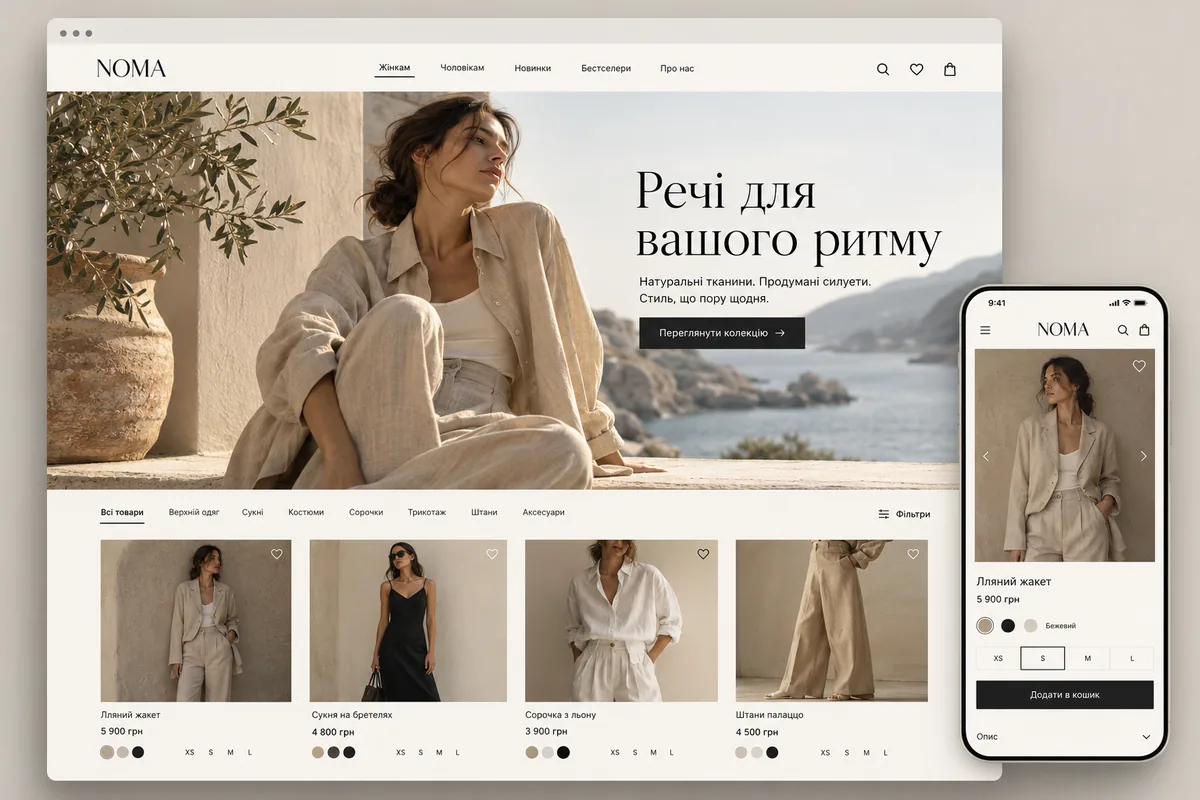
The buyer may like the item in the photo and not order it because of uncertainty with the size, landing or delivery. The online clothing store should help to pass this choice: find the desired category, see the fabric and details, choose an affordable option and understand the terms of purchase. We develop a store with the logic of your range: from a small collection of our own brand to a catalogue with different manufacturers. We agree on the payment of product data.
- 01
Choosing the right size
The table of measurements, model parameters and landing explanations help to assess the thing. Availability is shown for a specific combination of size and color.
- 02
Catalogue without unnecessary steps
The buyer goes to the desired type of clothing and narrows the choice with clear filters. On the phone you do not have to close several windows for the sake of viewing the goods.
- 03
Order with current data
The selected option, price and quantity pass through the basket to the processing system. Terms of delivery and payment become clear before the purchase is completed.
We start with a range, not a set of fashionable effects
Collections, images and the nature of things are important for our own brand. For a store of several manufacturers, categorization, brands, sizes and comparable characteristics are understandable. At the start, we analyze the sample of product data: what is considered a separate model, what are the colors, how the balances are accounted for. The catalogue structure and the work of the basket depend on this.
For example, one dress in three colors and five sizes is not just one photo with a purchase button. Combinations are required, the correct articles and the remainder of each option. If part of the size is missing, the buyer should see this before payment. Do not postpone this logic to the stage after approval of the design.
What should a clothing product page explain?
Photos convey the style, but for the solution you need specific data. We show the thing from several angles, fabric, parts and landing. The size chart should correspond to the manufacturer or model, and not be a universal picture for the entire store. If the model parameters are known, add them together with the size of the thing in the photo. Do not invent these characteristics by image.
| Card element | The question it answers | What the store provides |
|---|---|---|
| Photos and details | What does the thing and fabric look like | Own or allowed photos of good quality |
| Dimensions and measurements | Will the landing be | Tables and explanation of measurement method |
| Colour and variant | What exactly am I ordering | Articles, available combinations, color photos |
| Composition and care | How to Wear and Care for Things | Verified manufacturer data |
| Delivery and exchange | What will happen after registration | Actual rules of the store and terms of processing |
- CatalogueTypes of clothes and collections
- SubcategorySelection by appointment and style
- FiltersSize, color and other useful signs
- CardPhotos, measurements, option and balance
- BasketChecking selected items
- RegistrationDelivery, payment and confirmation
Filters that help you choose, not hide goods
The set of filters depends on the category. Season, length and material may be important for outerwear; for T-shirts - cut and size. We do not add dozens of fields that are filled only in part of the goods. First, we bring the characteristics to a single format, otherwise the same size can be in different values of the filter.
On the phone, we show active restrictions and the ability to quickly reset them. If there are no results, we explain the reason and suggest changing the parameters. Saving the choice when returning from the card helps to continue browsing. Categories and main subcategories should remain available with ordinary links, even if the search and filters work dynamically.
Payments, delivery and stock in one consistent system
We agree where the main source of commodity balances is: in the store, accounting system or in stock. We determine the frequency of synchronization and the moment of reservation. It is especially important if the latter unit can be simultaneously sold offline and online. Before launching, we check the behavior when the goods ran out between adding to the basket and registration.
Payment is confirmed through a verified provider response, not simply the customer returning to a success page. We plan retry, cancellation and refund flows. Manager notifications include the SKU, colour and size rather than leaving the team to reconstruct the choice from a model name.
| Conversation flow | The correct behavior of the store | What we check |
|---|---|---|
| No Size | Unavailable option is not sold as available | A separate remainder of each combination |
| The payment did not pass | A clear order status | Repayment without duplicate purchase |
| The product is sold offline | The data is consistent between channels | Synchronization and Reserve Rules |
| The buyer changes the option | The cart shows the current price and data | Correspondence of article, photo, amounts |
| Need an exchange | The client sees the order of treatment | Actual conditions and contact of the store |
Content that the store can support
We agree on the product product page template, characteristics names and rules for uploading photos. This helps to add the next collection without chaotic formatting. If there is a ready table or export from the system, we check it on a small sample before mass import. The cost of preparing data is separated from creating the template itself.
The image is optimised for quick viewing, keeping sufficient detail of the fabric. Large photos should not block the choice on the phone. For directories with several languages, we determine which fields are translated, and which remain codes and article data. The transfer of the store includes a clear order of changing the price, balance and description.
What determines the cost of an online clothing store
The number of products is important, but does not describe the complexity. Fifty ready-made models with simple options may require less work than a small collection with a non-standard configurator. The budget takes into account the structure, design, data processing, integration, payment and delivery methods, languages and transfer of the old store.
For the first version, we determine the necessary categories, high-quality cards, a basket and reliable registration. We add a loyalty program, complex recommendations, a wholesale buyer’s office or multi-warehouse accounting to a separate volume. An agreed list of functions makes it possible to understand what is included in the development and for which external services can be regular payments.
Checking the store before the first orders
We make a purchase on your phone and computer: category, filter, size selection, basket, delivery, payment and message. We test the missing option, promo code if available, change in quantity and rejected payment. We check that the amount and product data are the same for the client, manager and accounting system.
Analytics distinguishes product views, adding to the basket, starting checkout and confirmed purchases. Reopening the thank-you page must not count as another order. After launch, we compare events with actual payments, cancellations and exchanges to find selection and checkout problems rather than merely reporting visits.
Frequently asked questions
Which platform is better to make a clothing store?
The platform is chosen after checking the range, the necessary integrations and the team work process. For many tasks WordPress with WooCommerce can be considered, but the decision depends on the scope and requirements. First we define the user flows that the system should support.
Can I transfer goods from the table?
So, if the table contains agreed names, articles, options and characteristics. First, check several models and data structure. Cleaning duplicate values, selecting photos and filling in missing descriptions is a separate volume that we agree to import.
Does each colour need a separate product page?
Not always. Often it is more convenient for the buyer to choose the color and size inside one model. We determine separate addresses and how to present options by catalogue and search tasks. It is important that the price, photo and availability correspond to a specific choice.
Can I start a small collection and expand?
Yes. We lay the structure that you can fill with new models, but do not add all the possible functions in advance. For the first launch, high-quality data, a reliable basket and clear order processing are important. We agree on new integrations as needed.
Are there pictures and descriptions of all things?
The composition of the filling is determined in the estimate. We can work with finished materials or separately agree on their preparation. Data on the composition, size and care should come from the store or manufacturer; they should not be invented for a photo.
Prepared by the Cartel Digital team. The examples illustrate possible solutions; we agree the scope around your business needs.
We will discuss the store for your collection
Send an example of product data, the number of models and options and a list of the necessary payment and delivery methods. We will prepare the structure and composition of the first launch.